
You look in the mirror every morning. The pimples are long gone. But the skin still looks uneven, pitted, shadowed in certain light. You have tried creams. You have tried home remedies. Nothing has really changed. And somewhere in the back of your mind, you have started wondering whether this is just how your skin is going to look forever.
It is not. But here is the truth: most people are treating the wrong scar with the wrong method. That is why nothing is working.
Acne scars are not one thing. They are several very different problems sitting on the same face. And the moment you understand what you actually have, everything else becomes clearer.
What Is Actually Happening Under Your Skin
When deep acne inflames your skin, it damages the tissue underneath. As your skin tries to heal, it either makes too little collagen and leaves a depression, or too much and creates a raised lump. The result is permanent texture change. Not just a dark mark. Actual structural damage to skin.
Dark spots fade on their own. Scars do not.
This is the part most people miss. They spend months using brightening serums on marks that are not discolouration at all. They are dents. No cream fills a dent.
The Three Main Types You Need to Know
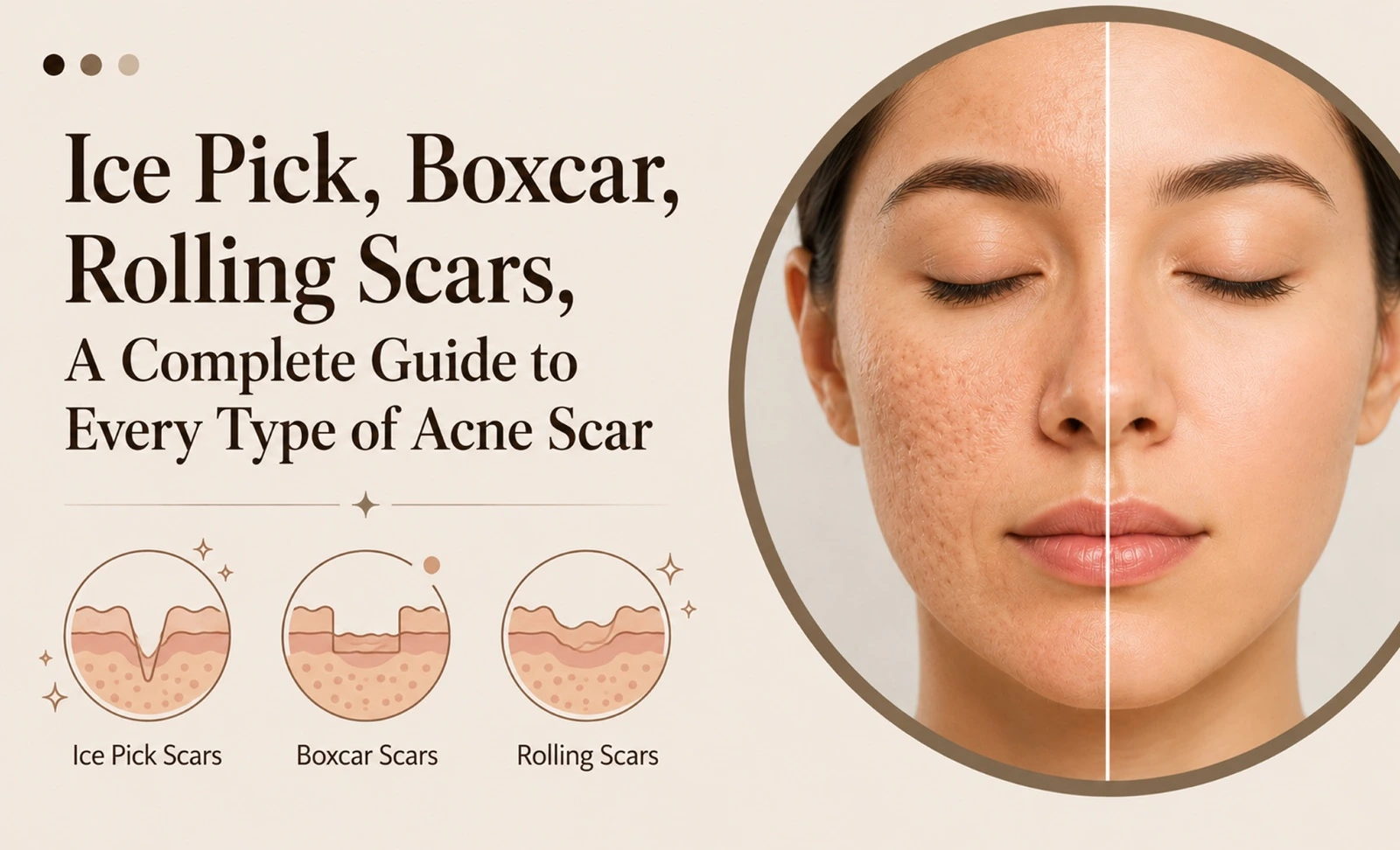
Ice Pick Scars: These are the narrow, deep pits that look like your skin was punctured with a sharp tool. Small openings at the surface. But they go deep into the dermis. Very deep. They are notoriously difficult to treat because surface treatments cannot reach their base. Lasers alone often disappoint here. TCA CROSS, a technique where a chemical agent is applied precisely inside the scar, is often the starting point. Followed by resurfacing sessions. Results take time. But they come.
Boxcar Scars: These are wider. Sharp, well-defined edges on round or oval depressions. They look like the skin has been pressed down in a clean box shape. Common on the cheeks and lower face after inflammatory or cystic acne. These respond well to fractional laser resurfacing and radiofrequency microneedling. Sometimes filler helps temporarily while longer-term collagen rebuilding continues.
Rolling Scars: These give your skin that uneven, wavy look, especially visible in morning light or sunlight falling at an angle. No sharp edges. The depression is broad and soft. What is causing the pull is fibrous tissue tethering your skin downward from underneath. Subcision, where a needle is inserted under the scar to release those fibrous bands, is often the most important first step here. Without releasing the tether, surface treatments give only partial improvement.
The most common presentation we see at Linae Clinic in Hyderabad is a combination of all three types on the same patient. That is normal. And that is exactly why treatment must be customised.
Why This Happens To You
Genetics play a role. Skin type plays a role. But mostly, scars come from delayed treatment, picking at breakouts, or severe cystic acne that caused deep inflammation before it was controlled.
Life causes this. Not carelessness. Not bad hygiene.
The psychological impact is real. Acne scars affect confidence in ways that are difficult to explain to someone who has not experienced it. Photographs feel like traps. Lighting in offices and malls becomes something you actively dread. These feelings are valid and they deserve to be taken seriously in consultation.
Diagnosis: This Is Where Things Go Wrong
The biggest mistake in acne scar treatment happens before any procedure begins. It happens in the consultation room.
A patient comes in. A single treatment is recommended without properly mapping scar types, scar depth, skin tone, and healing tendency. One laser session is done. Partial improvement happens. Expectations are unmet. The patient concludes that treatment does not work.
That is not a complication. That is a planning failure.
Good diagnosis means identifying which scar types are present, how deep they are, whether the skin has active acne still needing control, and what sequence of treatments makes sense. At Linae Clinic in Hyderabad, this assessment happens first. Always.
Procedure, Recovery, and Honest Risks
Treatments for acne scars include TCA CROSS, subcision, fractional CO2 laser, radiofrequency microneedling, chemical peels, and dermal fillers. These are used in combination based on scar type.
Recovery varies. Some procedures have two to three days of redness. Others need a week. Collagen remodelling continues for months after. You will not see final results in four weeks.
Honest risks: pigmentation changes, especially in Indian skin tones if sun exposure is not managed. Temporary worsening of texture before improvement. The need for multiple sessions.
No procedure eliminates scars completely. But significant visible improvement is realistic and achievable.
Why Linae Clinic in Hyderabad
In real life, this is what it looks like:
Every consultation begins with scar mapping under varied lighting before any treatment is discussed. Ice pick, boxcar, and rolling scars are treated with separate, targeted techniques in the right sequence. Indian skin tones are handled with specific protocols that reduce pigmentation risk. Costs are communicated transparently from the first visit. Results are tracked over time, not declared after one session.
Patients often say they wish they had come in sooner instead of spending money on products that could not do what a planned clinical approach can.
Frequently Asked Questions
Is the treatment painful?
Most procedures are done after numbing cream. Discomfort is minimal. Some techniques feel like pressure or mild heat. Nothing that is difficult to tolerate.
Will I get new scars from the treatment itself?
This is a common fear. When treatments are matched correctly to skin type and scar depth, this risk is very low. Poorly planned aggressive treatment on dark skin tones is where this risk rises. That is why planning matters.
What about the scars from treatment?
In month one, the treated area may look redder, slightly rougher. By month six, texture visibly smoothens. By month eighteen, you see the real, settled result. The trade-off is worth it.
How much does treatment cost?
At Linae Clinic in Hyderabad, treatment cost depends on scar type, number of sessions, and combination approach. Pricing is explained clearly before anything begins. There are no hidden charges added later.
Can acne scar treatment be combined with active acne treatment?
Yes, and often it should be. Treating scars while new acne is still forming is counterproductive. Both need to be taken care of in the right order.
Is this cosmetic or reconstructive?
For many patients it is both. Acne scar treatment is a legitimate medical intervention that restores skin structure damaged by disease. It is not vanity. It is restoration.
Enough.
You do not have to keep adjusting lighting before a photograph. You do not have to avoid mirrors. Acne scars are treatable. A proper plan, built around your specific scar types, makes the difference. Book a consultation with Dr. Praneeta at Linae Clinic in Hyderabad. First, figure out what you really have. The rest follows from there.
Clear skin is not a dream. It is a decision.