
You finally decide to do something about your acne scars. You search online. Two names keep appearing. CO2 laser. Microneedling. Both sound effective. Both have before-and-after photos that look convincing. And now you are more confused than before you started searching.
This happens constantly. And the confusion often leads to the wrong choice.
Here is the truth: both treatments work. But they do not work the same way, on the same scars, for the same skin. Picking the wrong one does not mean zero results. It means slower, weaker, more frustrating results. And in Indian skin tones, the wrong choice can also mean post-procedure pigmentation that sets you back months.
So let us settle this properly.
How Each One Actually Works
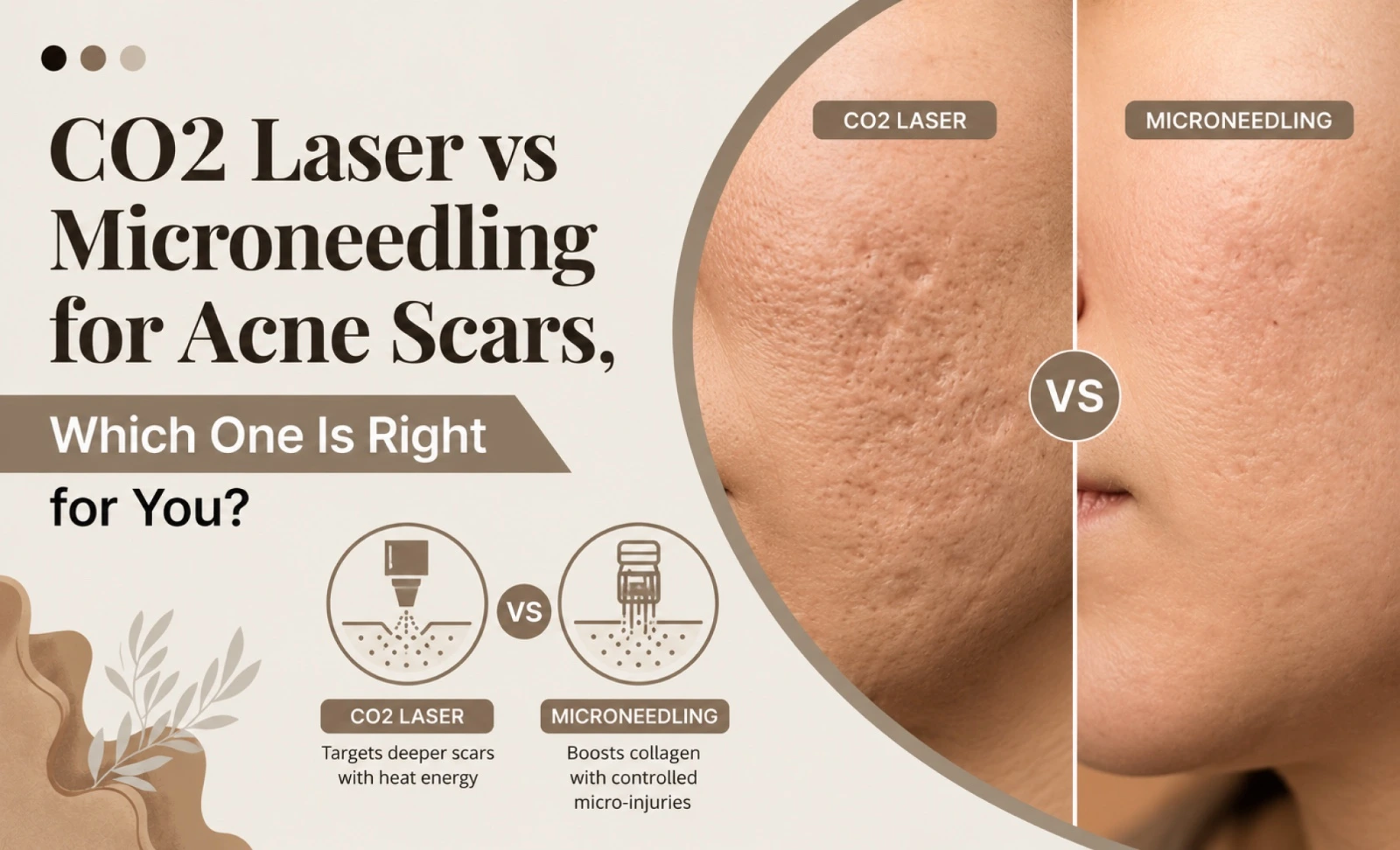
CO2 laser uses a focused beam of light energy to vaporise the damaged outer layers of skin. It removes. It resurfaces. It also heats the deeper layers, pushing the skin to produce new collagen from the ground up. The result is textural improvement that is often quite visible after even one session. The intensity can be adjusted, which matters when treating deeper scars on cheeks and temples.
Microneedling works differently. Fine needles create thousands of tiny, controlled punctures in the skin. No removal. No vaporisation. These micro-injuries trigger your skin’s repair response. Collagen production starts. Skin gradually fills in from below. Add radiofrequency energy to those needles and you get RF microneedling, where heat is also delivered inside the tissue, making the collagen response stronger and deeper without affecting the surface the way a laser does.
Two different mechanisms. Both valid. The question is which one suits your specific situation.
Which Scars Respond to What
Ice pick scars are deep and narrow. They go far into the dermis. CO2 laser resurfaces the surface but often cannot fully address the depth of an ice pick. Neither can standard microneedling alone. These scars usually need TCA CROSS first, before any resurfacing. This is the part most people miss when they jump straight to laser sessions.
Boxcar scars have sharp, defined edges and moderate depth. CO2 laser does well here. The resurfacing softens those edges, and the collagen response helps lift the base. Multiple sessions give progressive improvement.
Rolling scars have fibrous bands pulling the skin downward from underneath. No surface treatment fully corrects this without addressing the tether. Subcision first, then microneedling or CO2. Treating rolling scars with laser alone often gives surface smoothness but the underlying pull remains. That is not a poor result from laser. That is incomplete planning.
What we see often in consultation at Linae Clinic in Hyderabad is patients who have had laser sessions elsewhere with partial improvement, not because laser failed, but because the underlying scar structure was not addressed before resurfacing began.
Also Read: How Many Sessions Does It Take to Remove Acne Scars?
The Indian Skin Factor
This is critical and most comparison articles written for Western audiences do not say it directly enough.
Indian skin tones fall in the higher Fitzpatrick range. Darker skin has more active melanocytes. When you put aggressive laser energy on darker skin without proper protocol, those melanocytes react. You get post-inflammatory hyperpigmentation. New dark patches. Sometimes worse than the scars you were treating.
CO2 laser in experienced hands, with correct settings and proper pre-treatment preparation, can absolutely be used safely on Indian skin. But the margin for error is smaller. RF microneedling bypasses this risk more reliably because it delivers energy inside the skin, not through the surface. The epidermis stays largely intact. Pigmentation risk drops significantly.
This is why in darker Indian skin types with moderate scarring, RF microneedling is often the smarter first step. Not because CO2 is unsafe. Because RF is more forgiving, and results are still excellent.
Downtime: Be Realistic
CO2 laser requires real recovery. Redness, peeling, and sensitivity for five to seven days at minimum. Sometimes up to ten days. You cannot apply makeup immediately. Sun exposure during recovery causes problems. If your work or life does not accommodate a week of visible recovery, this matters.
Microneedling has much less downtime. Redness for twenty-four to forty-eight hours. Most people return to normal the next day. Multiple sessions are needed, typically four to six, spaced a month apart.
CO2 laser may need fewer sessions for equivalent improvement. But each session demands more recovery.
There is no universally better answer. There is the answer that fits your scar type, your skin tone, and your life.
Diagnosis and Planning: Where Most Clinics Get It Wrong
The most common failure we see is this. A patient walks in. A single treatment is recommended without examining what type of scars are present, how deep they go, whether there is active pigmentation, and what the realistic improvement timeline looks like.
That is not a treatment plan. That is a guess.
Good treatment for acne scars starts with a thorough scar assessment. Scar types mapped. Skin tone assessed. Sequence planned. CO2 or microneedling should not be the first option. It is the fourth or fifth decision, made after understanding everything else. At Linae Clinic in Hyderabad, this is how every consultation for CO2 laser or microneedling begins.
Why Linae Clinic in Hyderabad
This is how it looks on the ground:
Scar type and skin tone assessment happens before any treatment recommendation is made. CO2 laser and microneedling protocols are customised for Indian skin, not adapted from generic guidelines. Combination treatments are planned in the right sequence, not sold as add-ons. Pigmentation risk is discussed honestly and managed proactively. Costs are transparent from the first consultation.
Patients at Linae Clinic in Hyderabad regularly come after having partial results elsewhere, not because previous treatment was wrong, but because planning was incomplete.
FAQs
Which is more painful?
CO2 laser is more intense. Numbing cream is applied before both, but CO2 sessions involve more heat sensation. RF microneedling is generally well tolerated.
Will either treatment scar me further?
When matched correctly to skin type and scar depth, no. Aggressive CO2 settings on unprepared darker skin are where pigmentation risk rises. Proper pre-treatment and correct protocols prevent this.
How many sessions do I need?
CO2 laser: often two to three sessions for significant improvement. Microneedling: four to six sessions. Final results for both settle around the twelve to eighteen month mark after the last session.
Can both be combined?
Yes. Often the best outcomes come from a phased approach. RF microneedling to build collagen safely, followed by one or two CO2 sessions once the skin is well conditioned. This is what a layered treatment plan looks like.
What about cost?
At Linae Clinic in Hyderabad, costs are explained clearly before any session begins. Treatment recommendations are based on what your skin needs, not on what costs more.
Decide.
Stop comparing treatments in isolation. Start with understanding your scars. Then the right choice between CO2 laser and microneedling becomes clear, not confusing. Book your consultation with Dr. Praneeta at Linae Clinic in Hyderabad. One proper assessment changes everything.
The right treatment, planned right. That is all it takes.