

You have been applying that brightening serum for four months. Religiously. Every single night. And yet, you look in the mirror and those marks are still there. Some have faded a little. But some, honestly, look exactly the same. Maybe even worse.
Here is what most people never get told: acne scars and dark spots are not the same thing. Not even close. And treating one with the method meant for the other is like taking fever medicine for a fracture. It simply will not work.
This confusion is one of the most common things we see at Linae Clinic in Hyderabad. Patients come in frustrated, having spent thousands on the wrong products, because no one stopped to explain the actual difference.
Let us fix that right now.
How to Identify Acne Scars vs Dark Spots at Home
Run a clean finger across your face where the marks are.
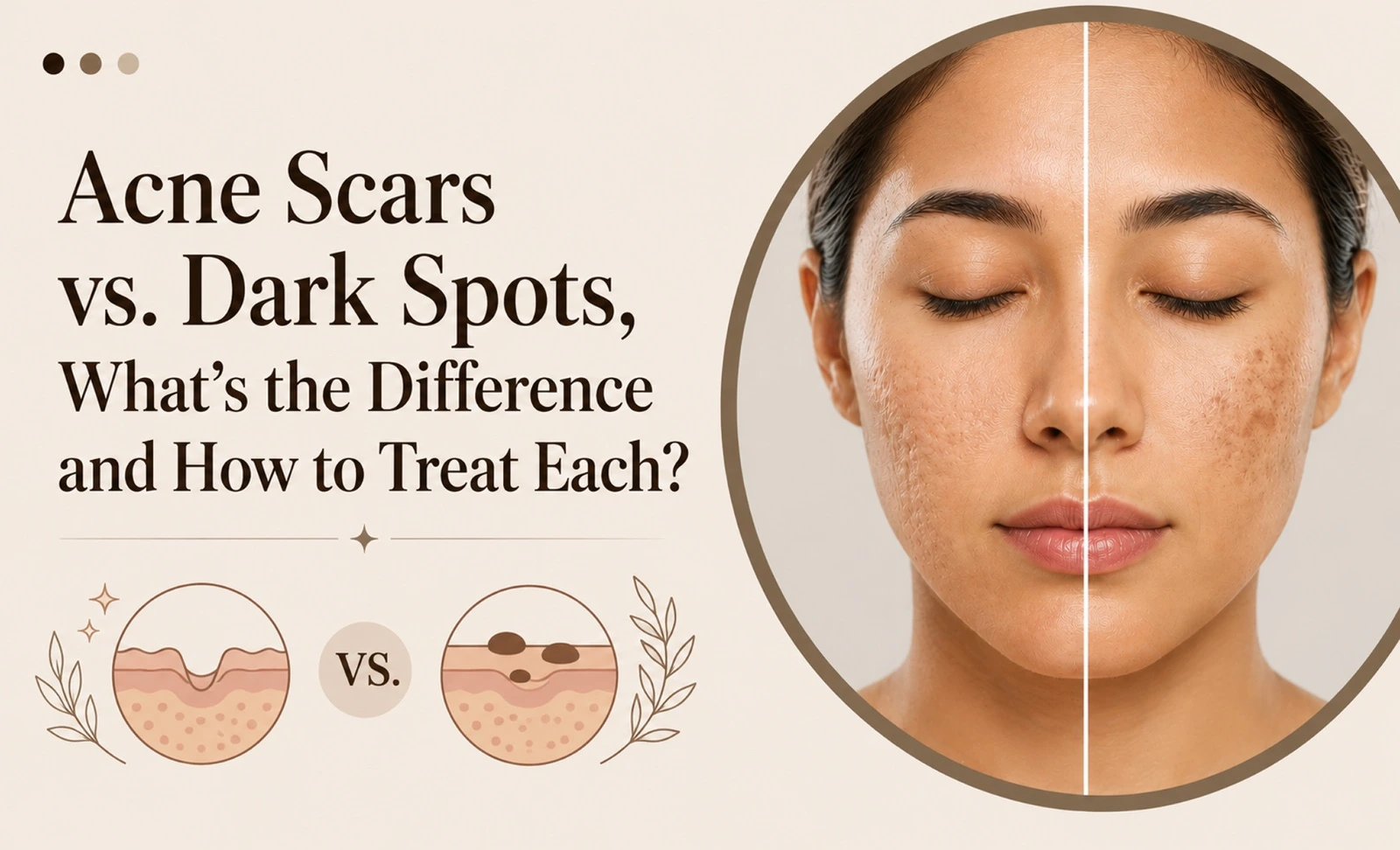
If the skin feels smooth and the mark is simply a colour change, brown or reddish or slightly purple, that is a dark spot. Medically, it is called post-inflammatory hyperpigmentation. Your skin got inflamed during a breakout, panicked a little, and produced excess melanin as a response. The structure of your skin is completely intact. Only the colour is off.
Now if that same area feels uneven, sunken, pitted, or raised under your finger, that is a scar. The inflammation went deeper. It damages collagen. And the skin, when it tried to heal, either produced too little collagen (leaving a dent) or too much (creating a raised bump). That structural damage does not simply fade with a brightening cream.
This is the part most people miss. The skin looks similar in both cases. But underneath, one is a colour problem and the other is a structural problem. Completely different treatment paths.
Types You Should Know
Dark spots come in two common forms. The flat brown patches that appear right after a pimple heals, and the pinkish-red marks that tend to linger, especially in lighter skin tones. Both are pigmentation issues. Both can respond well to the right topical treatments and professional procedures.
Acne scars have more variety. Ice pick scars are narrow and deep, like a small hole in the skin. Boxcar scars are wider with sharper defined edges. Rolling scars create a wavy, uneven surface. Hypertrophic or keloid scars are raised and can feel firm to touch.
At Linae Clinic in Hyderabad, the most common presentation we see is a combination. Patients have both active pigmentation and some degree of textural scarring together, which is why a proper diagnosis before starting any treatment is non-negotiable.
Why This Happens, and Why It Is Not Your Fault
Deep inflammatory acne, cysts, and nodules cause scarring more often than mild breakouts. Picking and squeezing dramatically increase the risk. So does delaying treatment of active acne, because every prolonged breakout is more collagen damage waiting to happen.
Dark spots are triggered by inflammation, sun exposure on healing skin, and hormonal fluctuations. In Indian skin tones, pigmentation can be stubborn and go deeper than it does in lighter skin. This is not a flaw. It is just how melanin-rich skin responds.
Life causes this. Not negligence.
Diagnosis: Where Things Go Wrong
Here is where most treatment failures begin. Not in the procedure room. In the consultation.
When a patient is not properly examined, when the type of scar is not identified, when someone simply looks at a face and recommends a standard laser without mapping the skin properly, the results will disappoint. That is not a complication. That is a planning failure.
A correct diagnosis by Dr. Praneeta at Linae Clinic in Hyderabad includes identifying whether you have pigmentation, textural scarring, or both. It includes understanding your skin tone, your scar depth, and your skin’s healing behaviour before deciding anything.
Skipping this step is the single biggest reason people feel that treatments do not work.
Treatment, Recovery, and Honest Risks
For dark spots, treatments like chemical peels, vitamin C, niacinamide, retinoids, and targeted laser therapy work well. Results begin showing in six to eight weeks. Sun protection during this period is essential, not optional.
For acne scars, deeper interventions are needed. Fractional laser resurfacing, microneedling with radiofrequency, subcision for rolling scars, and in some cases, dermal fillers for volume loss. Recovery typically involves three to five days of redness and mild swelling depending on the intensity of the procedure.
Honest risks: Temporary darkening after laser in deeper skin tones, post-procedure sensitivity, and the possibility that multiple sessions are required. Anyone who promises full clearance in one sitting is overpromising. Real results take time. They are worth it.
FAQs
Is the treatment painful?
Most procedures involve topical anaesthetic applied before the session. Discomfort is minimal and manageable. You will not be gritting your teeth.
Will treatment cause scarring or leave marks?
No, when done correctly, these treatments do not create new scars. Poor technique can, which is why expertise matters. In the first few weeks, skin may look pink, slightly textured, and sensitive—this is normal healing. Real smoothing shows over months. It’s a slow trade, but worth it.
How much does it cost?
Treatment cost at Linae Clinic in Hyderabad is discussed transparently during consultation. It depends on the type and severity of your concern. There are no hidden charges or pressure to book multiple sessions upfront.
Can acne scars and dark spots be treated together?
Yes. In fact, most patients need a combination approach. A well-planned protocol addresses both simultaneously, which shortens the overall treatment timeline.
Is this cosmetic or medical?
Acne scarring is a medical skin condition. Treating it is not vanity. It affects confidence, professional interactions, and mental health. It deserves to be taken seriously.
Why Linae Clinic in Hyderabad
Here is what that looks like in practice:
Every patient receives a detailed skin mapping before any procedure is recommended. Treatment plans are personalised based on scar type, skin tone, and healing capacity, not a standard package applied to everyone. Combination protocols are used where needed, because one treatment rarely addresses every layer of the problem. Pricing is explained clearly before you commit to anything. The focus is on long-term skin health, not quick fixes that fade in six months.
Patients who come to us having tried multiple treatments elsewhere often say the same thing: they wish someone had explained all of this to them at the beginning.
Enough.
If you have been staring at those marks every morning wondering why nothing is working, it is time to stop guessing and start understanding what your skin actually needs. Book a consultation with Dr. Praneeta at Linae Clinic in Hyderabad. Get a proper diagnosis. And begin a treatment plan that is built for your skin, not someone else’s.
Clear skin is not luck. It is the right plan, the right hands, and enough patience to let it work.