You searched this question because someone gave you a number. Three sessions. Six sessions. Maybe a clinic told you a package of eight. And now you are sitting here wondering whether that number is real, or whether it is just a sales pitch dressed up as medical advice.
Fair question. Let us answer it honestly.
The truth is that no doctor can provide you with a fixed number without examining your scars. Anyone who does is guessing. Or selling. The actual number depends on what type of scars you have, how deep they go, what treatment is being used, and how your skin responds. These four things vary from person to person. Significantly.
But here is what we can tell you clearly, so you go into any consultation informed.
Why There Is No Single Answer
Acne scars are not all the same structure. An ice pick scar goes deep into the dermis like a narrow tunnel. A rolling scar is tethered to deeper tissue by fibrous bands. A boxcar scar has sharp walls and moderate depth. Each of these responds differently, at different speeds, to different treatments.
It’s like expecting a hairline fracture and a deep tissue injury to heal in the same number of physiotherapy sessions, to expect all three to be treated with the same protocol and have the same timeline. The logic does not hold.
This is the part most people miss when they search for a session count online. The number they find is an average across all scar types. Their specific situation may be above or below that average.
What the Numbers Actually Look Like
For microneedling, including RF microneedling which delivers radiofrequency energy through the needles, most patients with moderate atrophic acne scars see meaningful improvement across four to six sessions, spaced four to six weeks apart. Sessions cannot be rushed. Collagen remodelling needs time between each sitting. Stacking sessions too close together disrupts the healing cycle and weakens results.
For CO2 fractional laser, the session count is typically lower, often two to three sessions for moderate scarring. But each session demands more recovery, and pigmentation risk is higher in Indian skin tones if protocols are not carefully followed. Fewer sessions does not automatically mean a faster or easier journey.
For chemical peels, especially TCA and glycolic acid peels used for surface improvement, anywhere from four to eight sessions is common, often used alongside other treatments rather than as a standalone solution.
For ice pick scars specifically, TCA CROSS is usually the starting step. This technique applies a precise amount of acid inside the scar to stimulate collagen from the base upward. This alone typically needs four to six applications before laser or microneedling is even started. Ice pick scars are not faster to treat. They are slower. Skipping this step and jumping to surface resurfacing gives poor results.
For rolling scars with fibrous tethering underneath, subcision must happen first. Without releasing the band pulling the scar downward, no amount of sessions above will give full improvement. The skin is being pulled down. You have to cut the anchor before you resurface.
The Session Count Changes Based on Severity
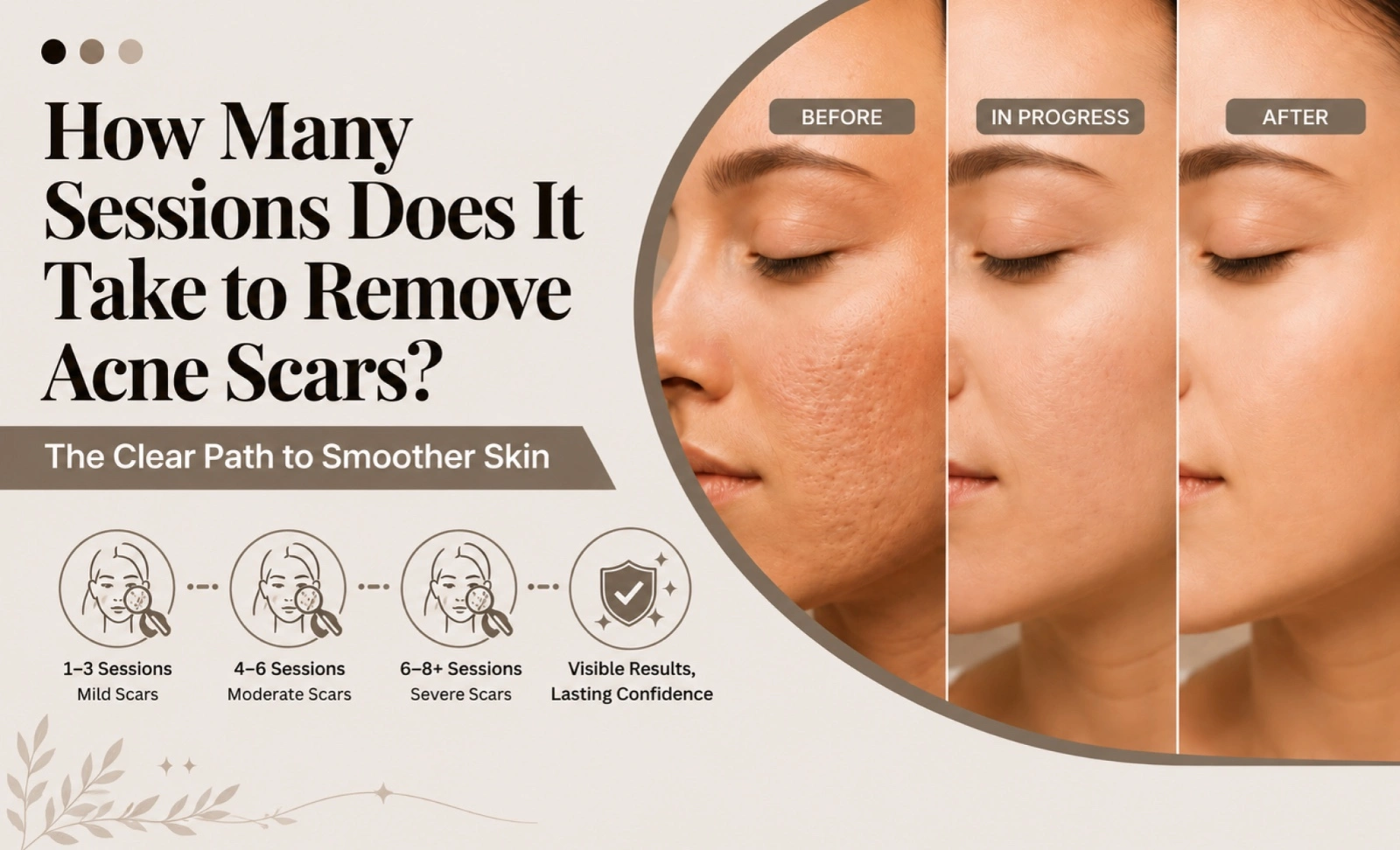
Mild scarring with shallow, spread-out texture changes can respond in three to four sessions of microneedling with visible improvement each time.
Moderate scarring, a mix of scar types across the cheeks and forehead, commonly needs six to eight sessions across a phased plan that may combine subcision, microneedling, and one or two laser sessions.
Severe scarring, deep scars of multiple types with significant skin texture loss, often needs a year or longer of structured treatment. This is not a failure of the treatments. This is the reality of what deep scar tissue requires.
What we see often in consultation at Linae Clinic in Hyderabad is patients who completed a fixed package at another clinic, saw partial improvement, and then were told nothing more could be done. That is not a medical conclusion. That is a business conclusion. Treatment can continue and evolve as the skin responds.
Also Read: What Is Vitiligo Surgery
When Results Actually Appear
This is equally important. Sessions are one number. Results are another timeline entirely.
After each microneedling session, the collagen response builds over weeks. You will not see the full result of session two until six to eight weeks after it. The final result of your last session continues improving for up to six months after treatment ends. This means a patient who finishes their last session in month five may not see their true outcome until month eleven.
At Linae Clinic in Hyderabad, patients are counselled on this clearly before starting. Realistic timelines, not rushed promises.
Diagnosis & Honest Risks
The session count goes wrong in the consultation room. Not in the procedure.
A patient comes in with a mix of ice pick, boxcar, and rolling scars. A package is sold without mapping scar types, without understanding depth, without planning a sequence. Six laser sessions are done on scars that needed subcision first. The skin improves partially. The patient is disappointed.
That is not the laser failing. That is planning failing.
Every treatment has a recovery period. Collagen does not rebuild overnight. There will be sessions where skin looks slightly worse before it improves. Redness, mild sensitivity, and texture fluctuation between sessions are normal. Indian skin types need specific post-session sun protection protocols to prevent PIH.
None of this is alarming. All of it is manageable when communicated honestly upfront.
Why Linae Clinic in Hyderabad
That’s what that looks like in practice:
Scar mapping is done before any session count is suggested. Ice pick, boxcar, and rolling scars are addressed in the correct sequence, not simultaneously with one generic protocol. Indian skin tones are treated with pigmentation risk in mind from session one. Session estimates are revised as skin responds, not locked into a rigid package. Cost per session and total plan cost are explained transparently in the first consultation.
Patients often come to Linae Clinic in Hyderabad after completing packages elsewhere that gave them half results. In most of those cases, the gap was in planning, not the treatments themselves.
FAQs
Can acne scars be completely removed?
Fully erased, no. Significantly improved to where they become very difficult to notice, yes. That is an honest and achievable goal.
How long between sessions?
Four to six weeks for most treatments. This gap is not optional. It is when the collagen builds. Rushing it reduces results.
Will I need maintenance after completing the plan?
Occasional maintenance sessions every six to twelve months help sustain results, especially if new acne breakouts occur.
Is scarring from the treatment itself a risk?
When treatment is matched correctly to scar type and skin tone at a clinic like Linae Clinic in Hyderabad, this risk is minimal. Aggressive settings on unprepared darker skin is where this happens.
What if I have already done sessions elsewhere with partial results?
Treatment can continue. A reassessment tells us what was addressed and what was not. Partial improvement is not the end point.
Start Here.
Not with a package. Not with a number someone gave you over the phone. Start with a proper scar assessment. Know what you have. Know what it needs. Know what realistic improvement looks like for your specific skin.
Book a consultation at Linae Clinic in Hyderabad. One honest assessment gives you a real plan. That plan gives you real results.
Good skin is not luck. It is the right sequence, done right.